
Free Crochet Mini Octopus Pattern Perfect for Gifts
Starting the adventure of crocheting a mini octopus brings together the joy of creativity and the satisfaction of making something adorable and memorable with your own hands. Using this easy-to-follow pattern, anyone can experience the pleasure of making a vibrant sea creature with simple supplies. This project encourages crocheters to enjoy the therapeutic process of single crochet stitches and quick assembly, making it ideal for both beginners and experienced crafters.
Easy Mini Octopus Crochet Pattern for Beginners (Free Tutorial)
The crochet mini octopus stands out for its compact, rounded body and charming spiral tentacles. With endless possibilities in color choices, each octopus can become truly unique—soft pastels, bright neons, or tranquil blues all work beautifully. This pattern primarily uses single crochet (the special stitch used), with straightforward increases and decreases to form the head, and chains followed by slip stitches for the curly tentacles. With only minor modifications, this base pattern can inspire a range of other creations: jellyfish, squid, or even a flower with curly petals, simply by changing the tentacle length and body shape. A simple adjustment in yarn color or a touch of embroidery opens up endless ways to personalize every creation.

Important Steps to Remember:
- Start with a firm slip knot and secure foundation chains for even work.
- Maintain consistent tension throughout for smooth stitches and uniform tentacles.
- Attach safety eyes or embroider simple faces before closing up the head for a polished look.
- Firmly stuff the head for a satisfying, plump shape.
- Carefully weave in all loose ends to keep the finished octopus neat and tidy.

Common challenges include loose or uneven tentacles, often solved by using a smaller hook (2.5 to 3.5 mm crochet hook) and double-checking stitch counts for accuracy. If the body appears lopsided, keeping track of increases and decreases helps ensure symmetry. Eyes need to be attached securely to avoid movement, with safety eyes or tight embroidery being excellent options.
Following these steps, using a 2.5 to 3.5 mm hook and worsted weight yarn, your finished mini octopus—or flower variant—should measure approximately 2 to 3 inches across. Attention to detail at each step and this clear guide brings rewarding results—a cute, colorful creation ready to brighten up any space or become a heartfelt handmade gift.

Cute crochet mini octopus
Meet your new favorite amigurumi friend: the adorable, palm-sized octopus! This pattern can be made in your favorite color. It’s perfect for gifts, decorations, or just to fill your home with cute sea creatures. With a cheerful round body, ruffled tentacles, and sweet face, this project is fun for beginners and experienced crocheters alike.
Skill Level & Terminology
- Skill Level: Beginner
- Terminology: UK terms in the video; US conversions given
- UK “double crochet” = US “single crochet”
Materials & Tools
- DK or light worsted cotton yarn:
- Main color for body and ruffles
- Pink for cheeks (optional)
- Black for embroidered eyes (optional)
- 3 mm crochet hook
- Darning/yarn needle
- Scissors
- Toy stuffing/filling
- Stitch marker (helpful)
- Safety eyes (or black yarn for sewn eyes)
Gauge
Gauge isn’t critical for amigurumi, but your octopus body after round 6 should be a neat sphere, about 2" in diameter.
Finished Size
About 2.5–3" (6–8 cm) across, depending on yarn and hook.
Abbreviations
| Abbreviation | UK | US |
|---|---|---|
| ch | ch | chain |
| dc | dc | single crochet (sc) |
| sl st | sl st | slip stitch |
| inc | inc | increase (2 dc/sc in same stitch) |
| dec | dec | decrease (2 dc/sc together) |
| FLO/BLO | FLO/BLO | front/back loop only |
Special Stitch Instructions
Increase (inc): Work 2 dc/sc in same st
Decrease (dec): Work 2 dc/sc together
Front/Back Loop Only: Only crochet into the loop closest/farthest from you, as directed
Pattern Instructions
PART 1: Main Octopus Body
Round 1
- Make a slip knot.
- Ch 2 (keep loose).
- In the first ch (the furthest from your hook), work 6 dc (US: sc) into the same chain.
- Do not join; you’ll work in a spiral.

Tip for Beginners:
This round forms the base of your octopus. No magic ring needed! Crocheting into the first chain gives a neat, easy start.
Round 2
- Use a stitch marker to mark the first stitch of each round.
- Work 2 dc (US: sc) in each stitch around (12 sts).
Now you are making the octopus grow! Each stitch gets 2, so your circle doubles in size.
Round 3
- Pattern: 1 dc in next st, 2 dc in next st around.
- (Repeat: 1 dc, 2 dc, 1 dc, 2 dc...)
- End round with 18 sts.

Alternating single and double stitches helps your piece expand and begin to form a sphere.
Round 4
- dc in each st around (18 sts).
No increases—just go around for an even shape. You should see the sides begin to curl up.
Round 5
- dc in each st around (18 sts).
Round 6
- dc in each st around (18 sts).
Work these rounds for height and volume. Your piece will become more ball-shaped.
Round 7
- Remove marker, place in the first st of the round.
- Begin decrease:
- dc in next st
- dec in next 2 sts (work together, front loops only/FLO)
- Repeat across round until you end with 12 sts.
Here, you start shrinking the sphere, making the bottom close in. Front loop decreases add a nice edge for attaching ruffles later!
Round 8
- Keep decreasing in back loops only (BLO) for extra texture:
- dec in next 2 sts (work together, BLO)
- Repeat around in pairs.
- Continue until you have a tiny opening.
- Stuff your octopus before closing the hole.
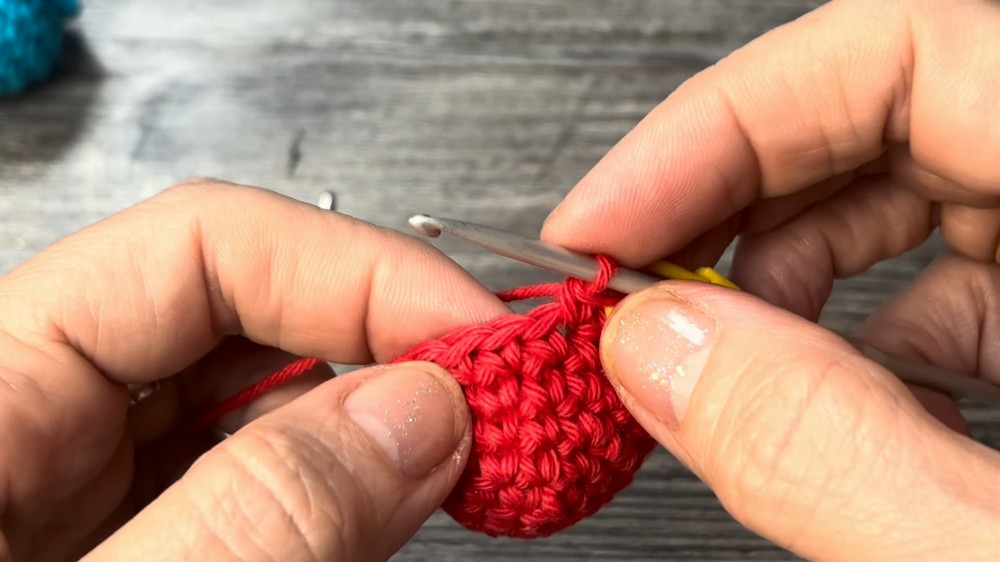
This closes the bottom and adds texture where the tentacles will go. Add stuffing before it gets too tight!
Final Step for Body
- When hole is tiny, finish off.
- Leave a long tail, use the darning needle to close any gap.
- Weave in the yarn securely.
Your octopus sphere is complete! Now it’s ready for the eyes, cheeks, and ruffles.
PART 2: Face and Cheeks
Eyes
- Attach safety eyes on round 4 (count down from top), spacing about 2 stitches apart.
- Or embroider eyes with black yarn:
- Bring yarn up from inside, stitch horizontally or in a dot, then fasten off securely.

Cheeks
- With pink yarn, embroider as for eyes, just left and right of the eyes.
Adding the face gives your octopus charm! Sewn or safety eyes both work. Pink cheeks can be stitched or blushed with embroidery floss.
PART 3: Ruffle Tentacles
- Use main color or contrast color yarn.
- Hold octopus body so bottom edge is facing you.
- Rejoin yarn with a slip stitch into a front loop round (from your earlier FLO decreases).
- In same stitch, ch 1 and 3 dc (US: sc) in same loop.
- In next front loop, work 4 dc (US: sc).
- Repeat 4 dc in each front loop around.
- Join with a sl st to the first chain of the round.
- Fasten off, weave in ends.
The ruffles create tentacles! Working into those front loops gives a neat frill. This step is a bit fiddly at first, but go slow and use your darning needle to weave in the tail ends.
PART 4: Finishing
- Trim excess yarn and weave in all ends neatly with your darning needle.
- Shape the stuffing for a perfect round ball.
Your octopus is done! The tentacles flare out naturally. Don’t worry if yours isn’t “perfect” – every octopus is unique.
EXPLANATIONS FOR BEGINNERS (after each part)
- Octopus Body:
You’re crocheting in a spiral, making a ball. Start with a small “circle,” then grow into a sphere, then close it up after stuffing. - Face/Cheeks:
Add your eyes before it gets too tight. Sewn or safety eyes work. (If embroidered, bring yarn up from the bottom and stitch back in.) - Tentacles:
The ruffle is made by stitching lots of crochets in each loop—this makes the frilly shape. Work slowly and check your progress as you go.
Assembly & Tips
- Make sure to stuff before finishing! Check tentacle placement for a symmetrical look.
- Use photos or diagrams for each step if you need a visual reference.
- If you’re unsure about stitches, search for “amigurumi single crochet increase/decrease” on YouTube or yarn sites.
Congratulations!
You’ve made your crochet mini octopus. Beginners will find each step builds naturally. Take your time with each round, and remember: if something looks odd, count your stitches or tug gently on stuffing to shape better.